


Facegenics Midface Expander (FME) for Adults in NYC
If an orthodontist has ever told you that you're too old for jaw expansion, the Facegenics Midface Expander, or FME, is worth a second look. This appliance widens the upper jaw and midface gradually, without the surgery that older expansion methods often required. Wall Street Orthodontics is one of the few practices in the Financial District offering the FME to adult patients, and we're always happy to welcome new patients looking for a second opinion on a case another office turned away. Dr. Lucas Shapiro also treats patients in Spanish, French, Chinese, and Portuguese, so residents and commuters across Lower Manhattan can talk through treatment in the language they're most comfortable using.
If you've already done some research on adult expansion, this page will help you understand exactly where the FME fits.
What Is the Facegenics Midface Expander?
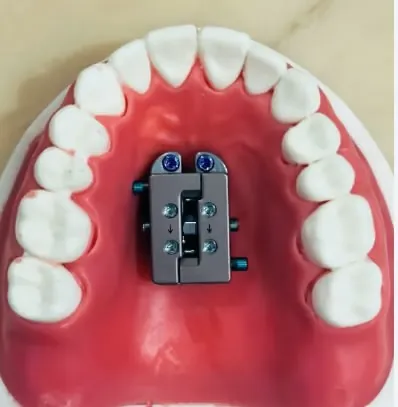
The Facegenics Midface Expander is a fixed appliance built to widen a narrow upper jaw and midface in patients who have finished growing. Unlike appliances designed for children, whose bones are still soft and easy to move, the FME was engineered with adult bone structure in mind. It applies steady, controlled force over time to gradually open the midface, correcting narrowness that contributes to crowding, crossbite, and in some cases, restricted nasal breathing.
How the FME Works, Mechanism and Tooth-Borne Design
The FME attaches to the back teeth and uses a small turning mechanism that's activated a little at a time, usually by the patient at home following our instructions. Because it's tooth-borne, meaning the force travels through the teeth rather than through screws anchored into bone, it tends to feel more familiar to patients who've had orthodontic appliances before. This design allows for meaningful midface movement without the incision or recovery time that surgical options require.
Who Is a Candidate for the FME?
Good candidates are typically adults with a narrow palate, midface constriction, dental crowding tied to a tight arch, or nasal breathing concerns who aren't a fit for surgery. Candidacy depends heavily on how fused your palatal suture has become, which we evaluate through imaging rather than guesswork. If your case turns out to need a different approach, our expansion services for adults and children cover a range of appliances beyond the FME.
Benefits of FME Treatment at Wall Street Orthodontics
Why Adult Patients Choose FME Over Surgery
Most adult patients come to us after hearing that surgery is their only option. The FME offers a path that skips the operating room, the general anesthesia, and the weeks of recovery that surgical expansion involves. Treatment happens at your pace, with regular monitoring in our office so we can adjust the plan as your midface responds.
Airway and Whole-Health Benefits of Midface Expansion
Widening the midface can also open up space in the nasal passages, which may help patients who deal with mouth breathing or restricted airflow. This is part of why we look at expansion cases through a whole-health lens rather than just a straight-teeth lens. If breathing and sleep quality are part of your concern, our airway-focused orthodontics approach digs into that connection in more depth.
FME vs. MSE, Comparing Midface Expansion Options
Patients often ask how the FME stacks up against the Maxillary Skeletal Expander, or MSE, since both are non-surgical options for adults. The table below breaks down the main differences so you can talk through the right fit with Dr. Shapiro.
| Feature | FME (Facegenics Midface Expander) | MSE (Maxillary Skeletal Expander) |
|---|---|---|
| Anchorage type | Tooth-borne | Bone-borne (miniscrews) |
| Surgical requirement | Not required | Not required |
| Suitable age range | Adolescents and adults | Adolescents and adults |
| Midface engagement | Yes | Yes |
| Invasiveness | Minimally invasive | Minimally invasive (implant-supported) |
| Airway impact | May improve nasal airway | May improve nasal airway |
Both appliances avoid surgery, but the anchorage type is the biggest practical difference. The FME relies on your teeth to transmit force, while the MSE uses small miniscrews placed in bone for a more direct skeletal grip. Dr. Shapiro will recommend one over the other based on your suture pattern, bone density, and how much expansion your case needs.
What to Expect During FME Treatment
Consultation, Imaging, and Custom Fitting
Every FME case starts with a consultation and a close look at your bite, followed by imaging to check how much your palatal suture has fused. We use 3D CBCT scanning to get a detailed, three-dimensional view of your midface before recommending any expansion appliance. From there, we take digital impressions and have your custom FME fabricated to fit your teeth precisely.
Activation Schedule and Monitoring
Once the appliance is placed, you'll follow an activation schedule, turning the mechanism a set amount on a regular basis, usually at home with clear instructions from our team. We check progress at scheduled visits, adjusting the pace if needed so expansion happens steadily and comfortably. This monitoring is part of why appointments with Dr. Shapiro run efficiently. If your visit is scheduled for a certain time, that's when you'll be seen.
What Happens If Midface Expansion Is Left Untreated
Putting off midface expansion doesn't just delay treatment, it can change your options entirely. A narrow midface tends to stay narrow or worsen over time, which can mean continued nasal airway restriction, crowding that keeps coming back even after other orthodontic work, and gradual skeletal changes that make the jaw harder to widen non-surgically. The longer a tight suture goes untreated, the more likely a patient is to eventually need surgically assisted expansion instead of an appliance like the FME. Addressing midface constriction earlier keeps more non-surgical doors open.
Frequently Asked Questions About the FME
Is the Facegenics Midface Expander painful?
Most patients feel pressure or mild tightness during activation, not sharp pain. This feeling usually fades within a day or two after each adjustment. Over-the-counter pain relief is rarely needed beyond the first few activations.
How long does FME treatment take?
Active expansion typically runs for several weeks to a few months, depending on how much widening your case needs. After that, the appliance stays in place for a stabilization period so the new bone can set. Dr. Shapiro will give you a timeline specific to your scan and goals.
Can adults really use an expander without surgery?
Yes, many adults are candidates for non-surgical expansion once bone density and suture patterns are reviewed on a CBCT scan. The FME was designed with adult anatomy in mind, which is different from expanders built for growing children. Not every adult qualifies, but more do than most patients expect.
How does FME compare to MARPE or SARPE?
FME is tooth-borne and does not require surgery, while MARPE uses miniscrews and SARPE involves a surgical procedure for more severe skeletal cases. Which one is right for you depends on how narrow the midface is and how fused your palatal suture has become. We review this with imaging before recommending a path.
Does insurance cover FME treatment?
Coverage for the FME varies by plan and by the reason for treatment. Our team can check your specific benefits and walk you through payment options once we have your details. Contact our office and we'll help you sort out what applies to your case.
Wondering If Your Midface Qualifies for Non-Surgical Expansion?
Reach out to our expansion and advanced treatment team at Wall Street Orthodontics to find out if the FME is the right next step for you.