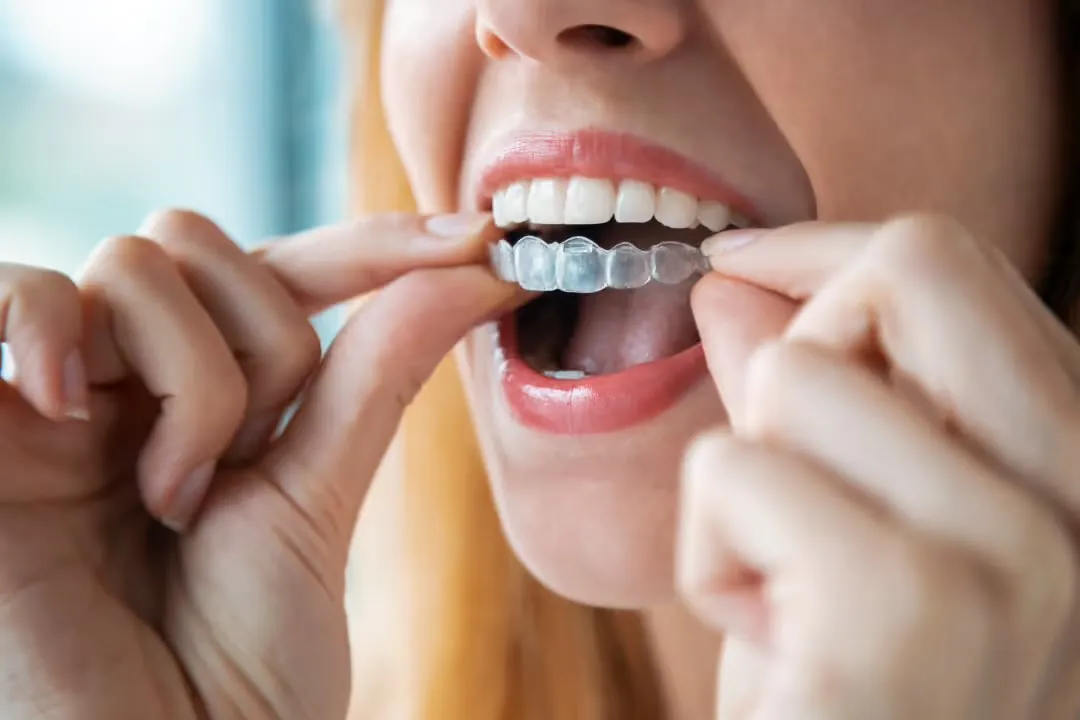
What Is Interproximal Reduction (IPR) in Invisalign?
Interproximal reduction, sometimes called slenderizing or stripping, means gently sanding a thin layer of enamel from the side of a tooth where it touches its neighbor. This opens up a sliver of space so your teeth have somewhere to go as your Invisalign aligners guide them into a straighter position. It's one of several tools an orthodontist has for treating crowding, alongside attachments, elastics, and, in some cases, expansion. Because Invisalign IPR works between individual teeth rather than across the whole arch, many patients with mild to moderate crowding can avoid an expander entirely.
How Much Enamel Is Removed During IPR?
Usually a tiny amount, often a fraction of a millimeter on each tooth surface, adding up to about half a millimeter of space between two teeth at most. Your orthodontist plans this out using your scans and X-rays ahead of time, so the amount removed is measured, not guessed. Enamel is thick enough to allow this kind of conservative reduction without ever exposing the softer layer underneath.
Does IPR Hurt?
Most patients feel nothing at all. Enamel has no nerve endings, so the process feels a bit like a nail file smoothing a rough edge. Local anesthesia usually isn't needed, and appointments for IPR are typically quick, in-office visits. Some patients notice mild sensitivity to cold for a day or so afterward, but it settles on its own.
How Invisalign IPR Fixes Crowding Without Expanding the Arch
Crowding happens when there isn't enough room along the jaw for every tooth to sit flat and straight. Expansion widens the arch itself to create room. IPR takes a different route: instead of moving the whole arch outward, it removes tiny amounts of space between teeth so they can slide closer together in better alignment. Your aligners then do the work of guiding each tooth into that new space over time. To understand how much movement is realistic at each stage, take a look at our post on how much teeth actually move with Invisalign.
When Is IPR the Right Choice for Crowding?
IPR tends to work well when a patient needs somewhere between one and four millimeters of extra space, and when the crowding is more about tooth size and spacing than a narrow jaw. It's also a good option for patients who would rather avoid an expander or a tooth extraction if a smaller adjustment can get the job done. Dr. Shapiro looks at your scans, your bite, and the shape of your arch before recommending it.
IPR vs. Expansion: How Orthodontists Decide
The right choice usually comes down to where the crowding is coming from and how much space treatment needs to create. Here's a quick side-by-side look at how the two approaches differ:
| Decision Factor | IPR | Expansion |
| Best for | Mild to moderate crowding from tooth size or slight overlap | Crowding caused by a narrow or underdeveloped jaw |
| Space created | Small amounts between teeth, often under 1mm per contact | Several millimeters across the whole arch |
| Effect on arch width | Arch width stays the same | Arch is widened |
| What's involved | Quick in-office enamel reduction, no appliance needed | An expander appliance worn over weeks or months |
In short, IPR works within the space you already have, while expansion creates new space by changing the arch itself. Age, severity, and whether the issue is skeletal or purely dental all factor into which path Dr. Shapiro recommends. For patients whose crowding is more complex or overlaps with jaw discrepancies, our guide to complex orthodontic cases walks through when expanders, extractions, or even jaw surgery come into the conversation.
What to Expect During and After IPR Treatment
Steps in the IPR Process
IPR is usually done at specific points during your Invisalign treatment, not all at once. Your orthodontist reviews your digital treatment plan, which maps out exactly which teeth need reduction and how much. During the visit, a small diamond-coated strip or disc is used to gently reduce the enamel between the targeted teeth. Afterward, the area is polished smooth and often treated with fluoride to help protect the tooth surface. Knowing exactly where and why IPR is planned matters, which is part of why treatment planning details make such a difference, as we cover in our post on rotation versus retention attachments in Invisalign planning.
Long-Term Enamel Safety and Outcomes
Because the amount of enamel removed is so small and carefully measured, IPR doesn't weaken your teeth or raise your risk of cavities over time. In fact, reducing overlap between crowded teeth can make those spots easier to clean, since food and plaque have fewer tight corners to hide in. For patients weighing IPR against other options for crowding, it's worth knowing that IPR is a much more conservative step than removing a tooth. If you're curious how extraction decisions can affect the shape of your smile and face, our article on whether orthodontic extractions harm facial aesthetics breaks that down in plain language.